
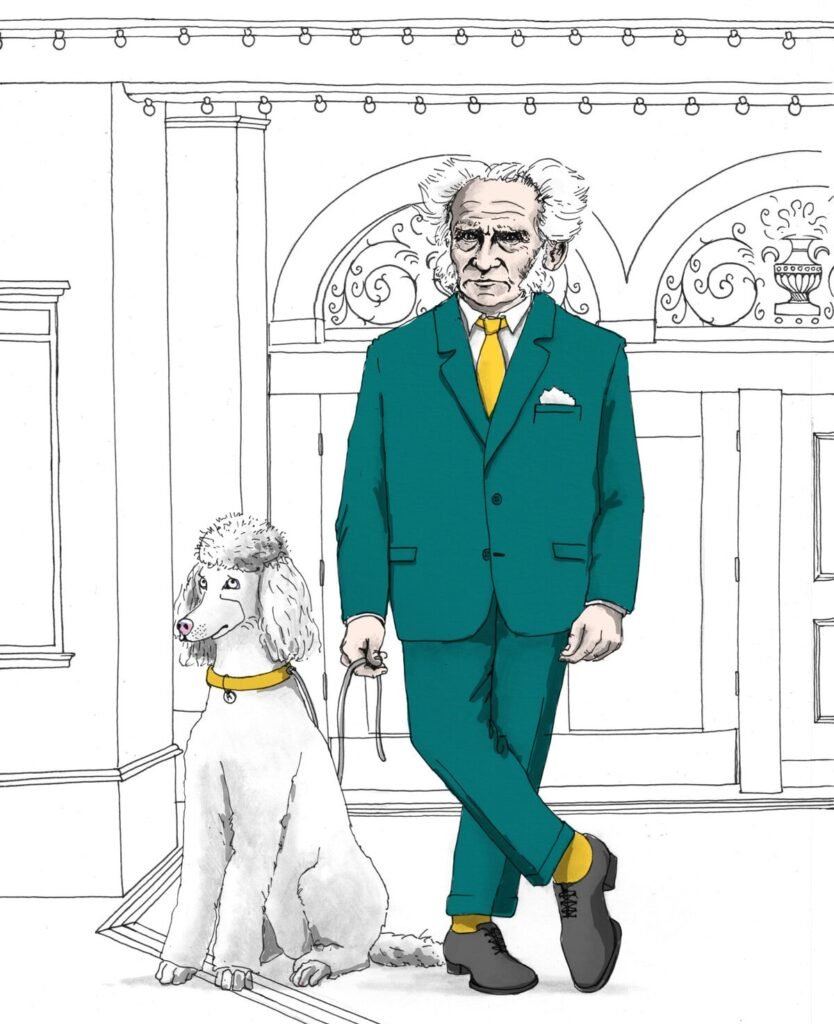
You all remember Arthur Schopenhauer, yes? I introduced you to him awhile back – he’s the 19th century German philosopher who lived alone and preferred his Poodles (a succession of them, all named Atma) to human companionship. Outside of the ancient Greek Stoics, I derive most of my personal philosophy from him. But unlike him, I chose a Chihuahua not a Poodle to be my companion. And, unlike him, I have never pushed a woman down a flight of stairs because she annoyed me. Yet.

The philosophy of Arthur Schopenhauer is often described as philosophical pessimism, but his thought is more complex than the simple belief that life is bad or that existence is meaningless. At the center of his philosophy is an attempt to explain why suffering is so pervasive, why human beings struggle endlessly to satisfy their desires, and whether genuine relief from this condition is possible. In his major work, The World as Will and Representation, Schopenhauer argues that the reality underlying the world we perceive is a blind, irrational force that he calls the Will. This force drives everything toward existence, survival, and continued striving without any ultimate purpose or final satisfaction. Because the Will is never completely satisfied, suffering becomes an unavoidable feature of existence. Yet Schopenhauer does not conclude that morality is meaningless or that human beings should be indifferent to one another. Instead, he argues that compassion, aesthetic experience, and the renunciation of desire offer different ways of responding to the suffering inherent in life.
Schopenhauer’s concept of the Will is the foundation of his entire philosophical system. By the Will, he does not mean conscious intention, rational decision, or personal choice. Rather, he means a blind and irrational force that underlies reality and expresses itself throughout nature. Human desires, animal instincts, and even natural forces such as gravity can be understood as manifestations of this underlying striving.

The world as we experience it is the world of representation: reality as it appears to us through perception and understanding. Beneath these appearances, however, Schopenhauer identifies the Will as the deeper reality that drives existence. Unlike a rational creator who acts according to a deliberate plan, the Will has no conscious purpose and seeks no final destination. It simply continues to strive.
This endless striving explains why existence is characterized by conflict, dissatisfaction, and suffering rather than by lasting harmony.
The consequences of this view become particularly clear in Schopenhauer’s account of human life. Human beings are driven by desires that arise from needs, instincts, ambitions, and expectations. Whenever we want something that we do not possess, we experience a sense of lack. We suffer because our desires remain unfulfilled, and we imagine that obtaining what we want will bring us lasting happiness. Yet satisfaction, when it finally arrives, is usually temporary. Once a particular desire has been fulfilled, another soon takes its place, and the process begins again. Even when we have nothing immediate to desire, we may find ourselves bored, restless, or dissatisfied with the absence of struggle. Schopenhauer therefore describes human existence as oscillating between pain and boredom: pain arises when we lack what we want, while boredom emerges when our desires are temporarily satisfied and life seems to lack stimulation. Rather than providing a permanent solution, the fulfillment of one desire merely prepares the way for another. Happiness, under these conditions, is fragile and short-lived, while suffering remains constant.
This understanding of human motivation also leads Schopenhauer to challenge the traditional belief that reason governs human behavior. People often imagine themselves to be rational agents who carefully examine their options and then decide what to do. Schopenhauer, however, argues that desires and instincts frequently precede conscious reasoning. Reason may help us determine how to achieve a goal, but it does not necessarily determine why we want that goal in the first place. We may pursue something because of deeper impulses and only afterward construct rational explanations that make our behavior appear deliberate and justified. In this sense, reason often serves the Will rather than controlling it. This emphasis on hidden motivations would later resonate with the work of Sigmund Freud, whose account of unconscious psychological forces similarly challenged the idea that people always understand the true causes of their actions.
Schopenhauer’s view of motivation is closely connected to his position on free will. He argues that human beings can act according to their desires, but they do not freely choose the desires themselves. His famous formulation captures this distinction: “A man can do what he wills, but he cannot will what he wills.”

We may be able to carry out an action that reflects what we want, but our wants are shaped by our character, instincts, and circumstances, none of which we simply choose at will. The feeling of making a free decision therefore does not establish that we possess complete freedom over the forces that determine our choices.
Schopenhauer rejects the notion that individuals are entirely self-determining, emphasizing instead the limits imposed by the underlying conditions of human motivation. His account presents people as agents who act through their desires without having ultimate control over the origins of those desires.
The same philosophy that explains human dissatisfaction also informs Schopenhauer’s understanding of evil and the problem of suffering. In traditional Western philosophy, the problem of evil often arises from the apparent contradiction between the existence of suffering and the existence of an omnipotent, omniscient, and perfectly good God. If the world was created and governed by such a being, why would it contain so much pain, cruelty, and injustice?

Schopenhauer approaches this question from a radically pessimistic perspective. Rather than treating suffering as a temporary defect within an otherwise good creation, he regards it as a consequence of the fundamental structure of existence itself. If the world is driven by a blind, irrational Will that continually strives without reaching lasting satisfaction, then conflict and suffering are not accidental exceptions. They are natural consequences of the force that drives life.
Schopenhauer consequently rejects the optimistic belief that this world is the best of all possible worlds. The suffering found in nature appears to contradict the idea that existence reflects the work of a perfectly benevolent creator. Predation, disease, starvation, war, and cruelty are not isolated problems that can easily be reconciled with an otherwise harmonious system. Living beings struggle against one another for survival and resources, and the continued existence of one organism may require the destruction of another. Human beings likewise compete for status, power, recognition, and other objects of desire. The Will manifests itself through this ceaseless conflict, producing a world in which the pursuit of individual satisfaction frequently comes at the expense of other beings. Schopenhauer’s response to the problem of evil is therefore to question the assumption that the world is fundamentally good. Suffering is not merely something that happens within existence; it is deeply embedded in the processes through which existence unfolds.
Nevertheless, Schopenhauer’s pessimism does not lead him to conclude that morality is meaningless. On the contrary, his recognition of universal suffering gives compassion a central place in his ethical philosophy. He rejects the idea that morality is grounded primarily in divine commands, abstract rules, or the pursuit of personal advantage. Instead, he argues that genuine morality begins with compassion, or Mitleid. Human beings ordinarily approach the world from an egoistic perspective, placing their own interests and desires first. Compassion allows them to recognize another being’s suffering as something that matters in itself, rather than merely as an inconvenience or an opportunity for personal gain. Through this recognition, the apparent separation between the self and others becomes less absolute. We begin to understand that other beings are also subject to the same fundamental forces of striving and suffering that govern our own lives.

For Schopenhauer, compassion is therefore the foundation of genuine moral conduct. Justice and loving-kindness arise when we recognize the moral significance of another being’s suffering and restrain our own selfish impulses accordingly.
Morality is not simply a matter of obeying rules because an authority commands us to do so.
Rather, its deeper purpose is to avoid inflicting suffering and to relieve suffering wherever possible. This principle also extends beyond human society. Schopenhauer showed considerable concern for animals, arguing that their capacity to suffer gives them moral significance. His position challenged the tendency to regard animals merely as instruments for human use and reflected his broader belief that suffering matters wherever it occurs. Although compassion cannot eliminate the suffering built into existence, it can prevent us from adding unnecessarily to it. In this way, Schopenhauer’s pessimism produces a strong ethical demand: we should recognize suffering honestly and respond to it with kindness rather than indifference.
In addition to compassion, Schopenhauer identifies art as a temporary means of liberation from the Will. Ordinary life is dominated by practical concerns, personal ambitions, and the constant pursuit of satisfaction. Aesthetic experience, however, can interrupt this cycle. When we become absorbed in a work of art, we may temporarily cease to think about what we want, what we lack, or what we hope to obtain. Instead of experiencing the world primarily in relation to our individual desires, we become detached observers, contemplating what is before us without immediately seeking to possess or use it. Art therefore provides a brief respite from the restless striving that characterizes ordinary existence.
Schopenhauer places particular importance on music, literature, and tragic drama. He regards music as especially profound because, in his account, it expresses the Will more directly than other forms of artistic representation. Music can communicate the patterns of longing, tension, conflict, and resolution that characterize human experience without relying on the depiction of particular objects or events. Tragic drama, meanwhile, reveals the suffering and conflict that lie beneath human aspirations, while literature can offer insight into the desires and struggles that shape our lives. Art does not permanently free us from the Will, since the experience eventually ends and ordinary desires return. Nevertheless, it provides a meaningful interval in which we can experience the world without being completely absorbed by striving.

Schopenhauer’s most radical response to suffering is the denial of the Will itself. Although compassion can reduce suffering and art can offer temporary relief, neither completely resolves the underlying problem. As long as individuals remain attached to their desires, they continue to participate in the endless cycle of wanting, striving, and dissatisfaction. Schopenhauer therefore argues that a deeper form of liberation requires a transformation in one’s relationship to desire.
Through detachment, simplicity, self-discipline, and the renunciation of excessive worldly ambitions, a person may gradually weaken the Will’s hold over their life. Rather than continually seeking new sources of satisfaction, the individual learns to relinquish the impulse to pursue them.
Schopenhauer’s account of this possibility was influenced by Indian religious traditions, particularly ideas associated with the Upanishads and aspects of Buddhism. These traditions offered perspectives on desire, attachment, and liberation that resonated with his belief that freedom from suffering requires more than the successful fulfillment of ordinary wants. The ascetic or saint represents the most radical expression of this transformation: someone who no longer identifies completely with the endless demand to acquire, achieve, and possess.

Such renunciation does not simply mean abandoning one desire in order to pursue another, since that would preserve the same underlying pattern. Instead, it involves a fundamental withdrawal from the restless striving through which the Will expresses itself. For Schopenhauer, this denial of the Will offers the deepest possible escape from the suffering inherent in existence.
Taken together, these ideas reveal the unity of Schopenhauer’s philosophy. His account of the Will explains why desire persists, why satisfaction remains temporary, and why suffering extends throughout the natural world. His rejection of complete free will follows from the same understanding of human beings as expressions of an underlying force they do not fully control. His analysis of evil challenges the assumption that existence is fundamentally benevolent, while his ethics of compassion insists that the prevalence of suffering makes moral concern more important, not less. Art offers temporary release from self-interested striving, and asceticism points toward a more radical liberation through the denial of desire itself. These ideas influenced later thinkers and artistic figures, including Friedrich Nietzsche, Richard Wagner, Sigmund Freud, and Ludwig Wittgenstein, as well as broader existentialist and psychoanalytic traditions.
Ultimately, Schopenhauer’s philosophy presents a difficult but coherent vision of human existence. The world is not governed by a rational purpose that guarantees harmony or lasting happiness, but by a blind Will whose endless striving generates conflict and dissatisfaction. Human beings cannot simply reason their way out of this condition, because reason itself often serves the desires that sustain it.
Yet Schopenhauer does not regard suffering as a reason to abandon moral responsibility.
Instead, he argues that recognizing the shared vulnerability of living beings should inspire compassion, while aesthetic contemplation and the renunciation of desire offer ways to loosen the Will’s grip. His philosophy combines a deeply pessimistic account of existence with a demanding ethical vision: although suffering may be inseparable from ordinary life, we can still refuse to intensify it, seek to relieve it in others, and pursue forms of liberation that move beyond the endless cycle of desire.
