
I am a huge fan of movies and television about my native Los Angeles. I am fortunate in that regard because Raymond Chandler essentially helped define the character of film noir through his Philip Marlowe novels, all set in LA. Growing up, any number of tv shows – like Dragnet, Adam-12, and even The Rockford Files – left me with the impression that I lived in a very special place. And a love for police procedurals.
So it should come as no surprise that when James Duff’s The Closer came out, I would tune in every week. And when Deputy Chief Brenda Leigh Johnson leaves the LAPD to run the investigative division of the LA district attorney’s office, and Captain Sharon Raydor takes her place in the spinoff series Major Crimes, my love affair with the show(s) and the city would continue.
Recently, Netflix added both shows to its lineup and I set myself a goal of watching them, in their entirety, from the first episode to the last in order. Usually two episodes a night, as I only watch tv/streaming after the sun goes down to keep from becoming a couch potato. Bear in mind The Closer ran for seven seasons (109 episodes), and Major Crimes for six seasons and 105 episodes! I’ve been at this for awhile.
With the exception of Assistant Chief Will Pope, Detective Sergeant David Gabriel, and of course Deputy Chief Johnson, the characters are the same throughout both series. So that’s 214 hour-long episodes to “get to know” them pretty well. I am currently up to season 5, episode 15 of Major Crimes, and last night, Assistant Chief Russell Taylor was shot and killed by a white supremacist. I cried.
I don’t just mean I was sad. I was sobbing, hyperventilating, tears rolling down my cheeks. I was inconsolable. Gordon had a very concerned look on his face.
There is something strangely unsettling about grieving for someone who never existed. When a character dies in a long-running television series, viewers sometimes experience genuine sadness, emptiness, anger, or even a sense of bereavement. They may cry, think repeatedly about the character, return to earlier episodes, or feel reluctant to watch the series continue without them. Intellectually, they know that the character was fictional and that the actor may be alive and well. Yet emotionally, the loss can feel remarkably real. This apparent contradiction reveals something fundamental about the way human beings form emotional relationships with stories, characters, and imagined worlds.
A fictional character can become part of a person’s psychological social world. Over dozens or even hundreds of hours, viewers watch a character experience relationships, conflicts, failures, triumphs, vulnerabilities, and changes. They learn the character’s habits, personality, fears, sense of humor, and ways of responding to other people. Eventually, the character can become familiar in much the same way that a person encountered repeatedly in ordinary life becomes familiar. The viewer develops expectations about what the character will say, how they will react, and what they are likely to do in a given situation.
This phenomenon is related to what psychologists call a parasocial relationship: a one-sided relationship in which an individual develops a sense of familiarity or attachment toward a media figure. With a fictional character, the relationship is even more obviously imaginary, but the emotional mechanisms involved can nevertheless be powerful. The viewer does not need to believe that the character literally exists in order to develop a meaningful psychological representation of them. Human beings routinely respond emotionally to things they know are fictional. A frightening movie can make someone’s heart race even though they know they are safe. A novel can make someone cry over events that never happened. Fiction works partly because the human mind is capable of simulating social and emotional reality.
The length of a television series can make this process especially powerful. Chief Taylor, played by Robert Gossett, appeared in 109 episodes of The Closer between 2005 and 2012, and 50 episodes of Major Crimes between 2012 and 2016. Initially, as Captain of the Robbery/Homicide division, he resents Chief Johnson and actively undermines her authority as his superior officer. Promoted to Commander, he is given the post of the newly-created “interdepartmental liaison” to assuage his ego; but this is largely an administrative job with no real command authority, and he becomes the subject of derision and a lot of eye-rolling.
When everyone moves from LA’s famed Parker Center building to the new police headquarters (which was an actual event in the city of Los Angeles that took place in 2009 and is a source of very real civic pride for Angelenos like myself), he is so insignificant that there is no office for him and he’s forced to work out of a cubicle, where the photocopier is located. His humiliation is further exacerbated by his fellow officers, essentially his subordinates, calling his workspace “the super cubicle.” But when Assistant Chief Pope moves up to become Chief of Police, he is promoted to assistant chief to fill that vacancy, and becomes everyone’s commanding officer.

100 West 1st Street, Los Angeles, CA 90012
A character who has been present for eleven years is not merely a character whom the viewer has watched. That character may have accompanied the viewer through an entire period of life. Someone may have watched a particular character while going to college, beginning a career, raising children, moving to a new city, falling in love, or dealing with difficult circumstances. The character can therefore become psychologically connected to memories of the viewer’s own life. For me, Chief Taylor was there when I walked into a hospital in West Hollywood and rolled out in a wheelchair. He was there when I moved to Palm Springs and struggled to accept my new life as a retired, disabled person who would never walk again. And until last night, he has been there every night over the last month.
When a character dies, the viewer may mourn more than the fictional person. They may also be mourning the world in which that person existed, the relationship they had with the story, and the period of their own life associated with it. The character may have become a kind of psychological landmark. Losing the character can therefore create the peculiar sensation that something from one’s own past has disappeared.
There is also an important distinction between a television series simply ending and a character dying. When a series ends, viewers can imagine that the characters’ lives continue somewhere beyond the boundaries of the story. They may never see those lives again, but nothing necessarily prevents them from imagining that the characters are still living, working, loving, aging, and changing somewhere outside the frame. Death is different. It closes those possibilities. The character can no longer have another birthday, form another relationship, make another mistake, grow older, or appear in a future episode. The character’s narrative future has been eliminated.
This can produce something resembling grief because grief is not only about the loss of what existed; it is also about the loss of what might have existed. A viewer may mourn the future they imagined for the character. All the possible experiences that seemed available to that person have suddenly been taken away. The viewer knows that this future was fictional, but it was nevertheless part of the imaginative world they had inhabited for years.
One of the strangest aspects of fictional grief is that people can simultaneously know that the character was never real and still feel that the character is gone. There is no contradiction in this. Human emotion does not depend entirely upon intellectual belief. A person can understand perfectly well that a story is fictional while responding emotionally to its events as though they were meaningful social experiences. The mind can maintain the knowledge that something is fictional while allowing the simulated experience to generate genuine feelings.
This becomes particularly apparent after a character’s death. Viewers may find themselves thinking, almost automatically, about what the character would have said or done in a particular situation. They may catch themselves expecting the character to appear in a scene, only to remember that they are gone. This can resemble, in a limited and importantly different way, the experience of continuing to mentally expect a person who has died in real life. The difference is that the fictional character was never physically present in the first place. What has been lost is the character’s continuing presence within the viewer’s imagined social world.
Some fictional deaths are particularly powerful because viewers have identified with the character. Perhaps the character represents loneliness, resilience, rebellion, vulnerability, ambition, failure, or the struggle to become a better person. Perhaps the viewer recognizes something of themselves in the character, or perhaps the character represents someone they once knew. In such cases, the death can resonate beyond the immediate plot. The viewer is not simply reacting to the disappearance of a fictional individual; they are responding to what that individual symbolized.
I had a particular affinity with Chief Taylor. I started out my career as someone’s secretary, and even had to cover the front desk when the receptionist was on her lunch break. My background in Philosophy was not particularly valued by my coworkers, and the fact that I was openly gay did not win friends or influence people; I remember one day when the lead sound mixer on Stage 5 passed me covering the phones in the lobby – he affected a very effeminate, fey voice, and in front of clients and coworkers said, “heeeeeeey sailor.” It was humiliating. Though it was for different reasons, Chief Taylor was mocked by his fellow officers, and I related to him because of that. And we both ended up defying expectations and overcoming animus to eventually be put in charge of some of the same people who had taunted us.
The reaction can become even stronger when the writers have spent years creating the character’s development. A character who has gradually changed over hundreds of episodes may feel almost like a person who has grown up alongside the viewer. The audience has invested time, attention, and emotional energy in that development. The longer the relationship continues, the more substantial the psychological representation becomes. Killing such a character can therefore feel less like removing a plot device and more like abruptly terminating a relationship that has been part of the viewer’s mental life for years.
This helps explain why fictional grief can sometimes produce surprisingly physical and persistent reactions. People may cry, feel empty, lose enthusiasm for continuing the series, repeatedly think about the character, or avoid the episode in which the death occurs. Some may become angry at the writers for making the decision at all. Others may find themselves returning to older episodes simply to spend more time with the character. None of these reactions necessarily indicate confusion about the boundary between fiction and reality. On the contrary, they can demonstrate how effectively the story created an emotionally meaningful world.
It would nevertheless be misleading to claim that grieving a fictional character is exactly the same as grieving a real human being. The death of a spouse, parent, child, friend, or other loved one involves the loss of an actual reciprocal relationship and can fundamentally alter a person’s daily life, social environment, responsibilities, and future. Fictional grief does not carry those same consequences. The distinction matters.
But acknowledging that difference does not require dismissing fictional grief as somehow fake. The object of the grief may be fictional while the emotion itself is genuine. A person can experience real sadness in response to an imagined event because the human mind is capable of forming emotionally powerful representations of people and worlds that exist only through narrative.
Perhaps this is one of the deepest things that stories reveal about us. Human beings do not experience their lives solely through direct physical contact with other people. We also inhabit worlds constructed in memory, imagination, language, and narrative. We become attached to people we have never met, places we have never visited, and lives that have never actually existed. A fictional character can become part of that inner world through years of repeated attention.
That may be why the death of a fictional character can feel so peculiar. We know, rationally, that no actual person has died. The actor may still be alive. The character was never physically present. Yet something meaningful has nevertheless been taken away: a familiar presence, a continuing story, a set of imagined possibilities, and perhaps a small piece of the viewer’s own history.
In that sense, a great long-running television character becomes something more than a collection of lines written by a screenwriter and performed by an actor. Over time, the character becomes a resident of the viewer’s imagination. They occupy a place in memory, participate in an imagined social world, and become associated with real experiences in the viewer’s life. When the story finally kills them, the viewer is confronted with the strange experience of losing someone who never physically existed but who nevertheless existed psychologically.
The grief is therefore not necessarily evidence that the viewer has mistaken fiction for reality. It may instead be evidence of how profoundly human beings are capable of responding to stories. We know the character was never real, yet for years we allowed ourselves to care about them as though their life mattered. When they die, the emotional consequences of that investment can remain long after the credits roll.
The character was fictional. The attachment was not.
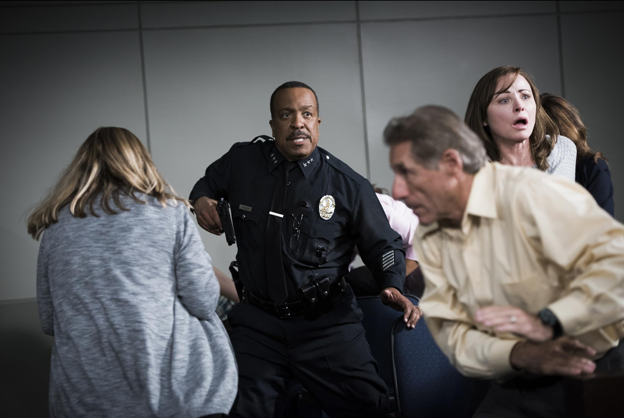
giving his life defending the public from a madman with a gun on a shooting spree
Last night, Acting Assistant Chief Howard tells the officers, “Chief Taylor died a hero.” And Captain Raydor adds, “And that is how he will be remembered.”
