
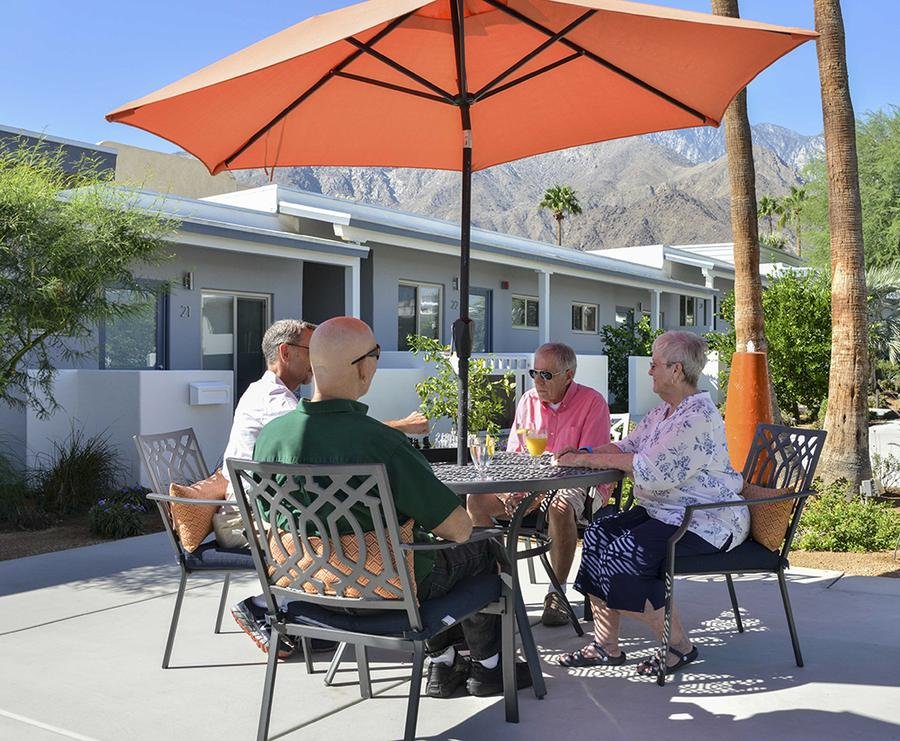
As one walks the winding garden path under the palm trees in the lush green courtyard, you can imagine Tab Hunter sunning himself on one of the patios, sipping a piña colada, or gay silent film star Ramon Novarro checking-in with a rent boy whose acquaintance he’d made hours earlier at Toucans Tiki Lounge next door. Stonewall Gardens Assisted Living began life as a Palm Springs resort called The Desert Moon, but was transformed in 2015 into Southern California’s first and only retirement home of its kind focused on the unique lives and needs of its LGBTQ+ residents.

Eleven years on, it stands today, like its famous namesake the Stonewall Inn in New York City, as testimony that gay lives matter. From sensitive and caring staff in tune with the unique history and culture of the LGBTQ+ community, to professional and compassionate management bringing their experience and common sense to bear on the healthcare and practical needs of seniors, the disabled, and those just needing to recover from an illness or an injury, Stonewall Gardens is a mid-century modern oasis in the Southern California desert, two hours from Los Angeles, but a world away from its congestion and busyness.
When I retired to Palm Springs nineteen years ago, I was looking for something different. As a proud native Angeleno, who made the City of Angels home for the first 41 years of my life, I sought a slower pace and a quieter lifestyle, but not one that would put me to sleep or reverse a lifetime of pride in myself as a gay man. It took me another eight years, but when I found Stonewall Gardens I knew I was “home.”
If, like me, you require assistance to get through the day, that can be found almost anywhere. A whole industry has grown up around serving the needs of aging and ill or impaired populations. But if you’re a gay man who doesn’t want to have to remember to modify his vocabulary when talking about his wife when he means husband, or, like me, an HIV+ gay man who wants to share that his latest labwork showed an encouraging increase in T-cells and an undetectable viral load without setting off bigoted homophobic alarm bells, well, in those cases you’re out of luck. Healthcare and related services are overwhelmingly centered on the majority heterosexual population.
But that does not mean the LGBTQ+ community doesn’t need, and have a right to, healthcare and related services, nor that we should go back into the closets we spent a lifetime coming out of to get that healthcare and the associated physical, mental, social, spiritual, and just plain practical needs that arise from it. Stonewall Gardens understands this. As an eleven-year resident of the community, I’ll go a step further: Stonewall not only understands this, it “gets” it in a way that all the sensitivity training and socio-cultural workshops in the world, in vogue now in the healthcare industry, could never appreciate.
Why? What is the “secret sauce?” It’s the community of men and women who live here. At other, what we might call “traditional,” assisted living facilities, your task as a resident is to adjust and fit into that facility’s culture. But at Stonewall Gardens, residents define the culture and your task is to enrich it by sharing your story. From veterans of the armed forces to retired clergy, from reminiscences of forty-year relationships to tales of wild one-night stands, and the sorrow we all carry for those lost in the darkest days of the AIDS crisis, every new move-in signals a new chapter, a new story, a new perspective.
And that is what I like to call “the Stonewall difference,” or as I’m fond of saying when some wide-eyed prospective new resident is here kicking the tires, “when you can no longer live alone, why not live with your own?”
A decade into my residency, I tell people I got “30 to life with no possibility of parole,” but I’m rethinking that quip as it makes my time here sound like a prison sentence, and nothing could be further from the truth. In reality, I know of no prison with a nightly happy hour before the evening meal! Or a slushie machine for fruit-flavored frozen treats to cool off on a hot summer’s afternoon. Or a morning exercise class set to the sound of disco music. Ringo the therapy dog visits from Animal Samaritans once a week, Ron volunteers to cut hair, “Jim the Tech Guy” will help you find that picture on your phone your niece sent or just show you how to operate the satellite TV remote, and Chuck is always up for a game of Scrabble. Or Parcheesi. Whether volunteer or staff, two-legged or four, everyone at Stonewall is here to assist you with your living.
Being the last surviving member of the original community (owing to the fact I was only 49 when I moved in), I wanted to take a moment to look back and look forward. As Stonewall forges ahead with its second decade, I am mindful of all the lives that have gone before, touching me and this place, walking the courtyard to get one of Regina’s pancakes as the sun dawns over the Coachella Valley. Today we stand on their shoulders. Tomorrow, others will stand on ours. All of us echoing the Stonewall Gardens motto… GAY! GRAY! HOORAY!
