
Our director here at my LGBTQ+ retirement residence is a heterosexual woman. Two weeks ago at Pride she was harassed for that fact when she so identified while staffing our booth at the festival by gay men who told her she had no business being there or doing the job she does. This makes me sad.

The LGBTQ+ community has spent decades fighting for equality, acceptance, dignity, and the right to exist openly without fear of discrimination. Its history is marked by real struggles – criminalization, harassment, violence, rejection by families, discrimination in employment and housing, and exclusion from public life. The fight for equal rights has been necessary, justified, and is far from over in many parts of the world.
But an uncomfortable question needs to be asked: When does the pursuit of inclusion become a justification for excluding others?
In some corners of LGBTQ+ culture and advocacy, a desire for safety, solidarity, and community has evolved into an attitude that views straight people not simply as outsiders to a particular experience, but as people who are inherently unwelcome, suspect, or undeserving of participation. When exclusion is justified solely by someone’s heterosexuality, regardless of their conduct, beliefs, or willingness to show respect, it raises a question of fairness that should not be dismissed simply because the exclusion is directed at the historically dominant group.
There is a difference between creating spaces specifically designed for gay people and deciding that straight people are categorically unwelcome because of their identity. That distinction matters.
Gay people have every right to create spaces where they can socialize, connect, share experiences, celebrate their culture, explore their identities, or find support among people who understand what it means to be gay. LGBTQ+ support groups, private affinity spaces, community organizations, and certain events can serve important purposes. There is nothing inherently wrong with seeking community among people who share experiences that others may not fully understand.
But the existence of a legitimate need for community does not automatically justify every form of exclusion, nor does a group’s history of discrimination grant it unlimited moral authority to discriminate against others.
One of the troubling developments in identity-based politics is the tendency to treat individuals as representatives of entire groups. Straight people, for example, may be characterized as inherently privileged, oppressive, ignorant, intolerant, or incapable of understanding LGBTQ+ experiences. Their individual character, beliefs, actions, and relationships with the community can become irrelevant. Their heterosexuality alone is treated as sufficient reason to distrust, dismiss, or exclude them.
That is collective judgment.
A straight person who has supported LGBTQ+ equality throughout their life, defended gay friends and family, attended Pride, advocated for equal rights, and treated everyone with dignity may still find themselves unwelcome in certain spaces simply because they are straight. Meanwhile, someone who is gay but hostile, disrespectful, or prejudiced may be welcomed simply because they share the group’s identity.

If identity becomes the determining factor rather than behavior, the underlying principle is no longer inclusion or fairness.
It is tribalism.
The irony is difficult to ignore. For years, gay people have argued – rightly – that they should not be judged by their sexuality, that being gay says nothing inherently negative about someone’s character, and that people should be accepted as individuals rather than reduced to stereotypes. Yet when those same principles are not extended to heterosexual people, the argument for universal equality becomes inconsistent.
The history of discrimination against gay people is real. Sometimes it has turned violent. It should never be minimized, trivialized, or forgotten. But historical mistreatment does not automatically justify present-day exclusion of individuals who had no role in perpetuating it.
The argument that straight people should be excluded because heterosexual society historically discriminated against gay people risks assigning inherited moral responsibility to individuals simply because they belong to the majority. It assumes that heterosexuality itself carries a moral burden, regardless of the person’s actual conduct or beliefs.
That is an intellectually and morally problematic position.
A straight person today is not automatically responsible for the actions of people who persecuted gay people decades or centuries ago. Nor is every heterosexual person privileged in every aspect of their life. People experience disadvantage, hardship, poverty, disability, abuse, and marginalization in countless ways that cannot be reduced to sexual orientation. Treating all straight people as a monolithic group of privileged oppressors ignores individual realities just as surely as stereotyping gay people does.
Historical injustice should inform our understanding of the present. It should not become a mechanism for assigning guilt by association.
The phrase “safe space” has become central to the conversation about LGBTQ+ community. And there are legitimate reasons for it. Gay people want spaces where they don’t have to explain themselves, defend their relationships, worry about being judged, or navigate the discomfort of being a minority. Stonewall Gardens, where I live, is one such space.
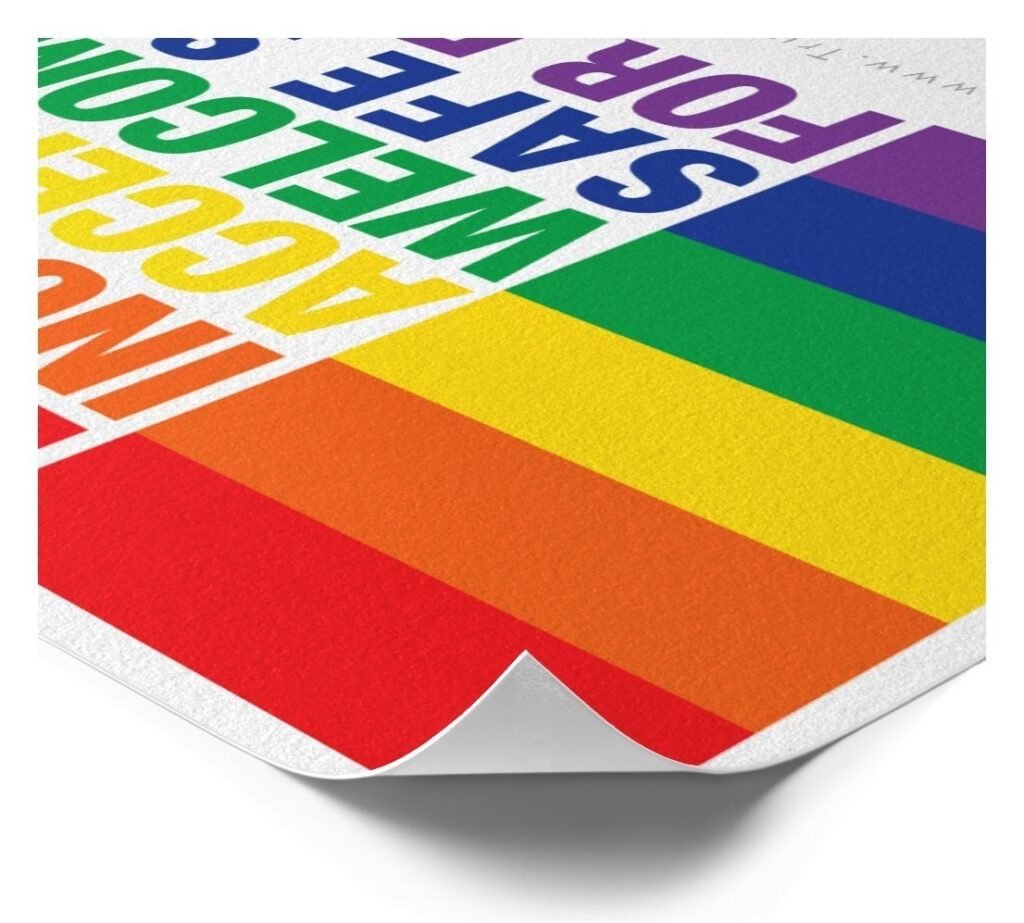
But there is a distinction between creating a space that serves a particular community and cultivating hostility toward everyone outside it. Moreover, people are often surprised when I tell them that Stonewall Gardens – the first and only LGBTQ+ assisted living facility in Southern California, a place both historic and necessary, a place I am proud, along with my Chihuahua, to call home, a place I wake up grateful for every day – was conceived of, financed, renovated, and founded by two straight men, both with families of their own, and that they still own and operate it today.
A gay support group designed for people discussing their experiences of coming out, discrimination, family rejection, or sexual identity is understandable. A private gathering intended to foster connection among gay people is equally understandable. An assisted living facility focused on the unique lives of gay seniors or disabled people is necessary to address the needs of an underserved population. These are purpose-specific spaces.
However, when the rationale shifts from “this space exists to serve a particular need” to “straight people are inherently unwelcome because they are straight,” the reasoning becomes more difficult to defend. When heterosexuality itself is treated as a disqualifying characteristic, the issue is no longer simply about privacy, affinity, or shared experience. It becomes an identity-based exclusion that deserves scrutiny.
The purpose of a space matters. The context matters. The nature of the exclusion matters. A private affinity group is not equivalent to denying someone access to a public service, employment, education, or a meaningful community opportunity. But the principle of fairness still deserves consideration, even in settings where exclusion may be socially accepted or legally permissible.
Another concern arises when questioning exclusionary attitudes is itself treated as an offense. If someone suggests that straight people should not automatically be excluded, stereotyped, or treated with hostility, the response may be to accuse them of being homophobic, insensitive, or incapable of understanding the LGBTQ+ experience.
This creates an environment in which the policy or attitude is protected from criticism not because it is necessarily fair, but because questioning it is framed as an attack on the community. That is not a healthy foundation for dialogue.
A community that advocates tolerance, acceptance, and freedom from prejudice should be capable of examining its own attitudes toward others. The legitimacy of a concern should not be determined solely by the identity of the person expressing it. A straight person can raise a valid concern about unfair exclusion. A gay person can disagree with aspects of LGBTQ+ activism without being a traitor to their community. And criticism of exclusionary behavior is not automatically criticism of gay people as a whole.
No group should be above examination simply because it has experienced historical discrimination.
At the heart of this issue is a fundamental question: Are we advocating equality as a universal principle, or are we advocating favorable treatment for our own group?
If discrimination based on sexual orientation is wrong, it should be wrong regardless of the target. If people should not be excluded, stereotyped, or denied opportunities because they are gay, those principles should also be applied consistently to straight people when the circumstances warrant it.
This does not mean every space must be open to everyone. It does not mean gay people must welcome straight people into every gathering, event, support group, or private community. Nor does it mean historical discrimination should be ignored or that the need for LGBTQ+-specific resources has disappeared.
It means that the justification for exclusion should be examined honestly rather than automatically accepted based on the identity of the people involved.
There is a difference between saying, “This space exists for gay people to discuss shared experiences,” and saying, “Straight people are unwelcome because straight people are the problem.” The first establishes a purpose. The second makes a sweeping judgment about people based on identity.
The distinction is not insignificant. It is the difference between community-building and collective prejudice.

The LGBTQ+ movement’s most powerful moral argument has always been that people deserve dignity, equality, and freedom regardless of their sexual orientation. That argument loses some of its strength when those principles are applied selectively.
A movement that condemns prejudice but tolerates hostility toward an entire identity group risks undermining its own credibility. A movement that demands acceptance but treats acceptance as a one-way obligation risks replacing mutual respect with moral entitlement. And a movement that uses historical grievance to justify present-day stereotyping risks perpetuating the very mindset it has spent generations challenging.
The point is not to equate every instance of exclusion from a gay affinity space with the systemic persecution gay people have historically experienced. The scale, context, history, and consequences matter enormously. But acknowledging those differences should not require abandoning the ability to recognize unfairness, hypocrisy, or prejudice when they occur.
You can recognize the historical oppression of gay people, support LGBTQ+ rights, celebrate Pride, defend equality, and respect the need for gay-specific spaces while simultaneously opposing hostility toward straight people based solely on their sexuality. These positions are not contradictory. They are consistent with the very principles of fairness and individual dignity that underpin the struggle for equality.
The goal of equality should be to dismantle the barriers that divide people based on identity – not to create new barriers and defend them with the language of justice.
If the ultimate aspiration is a society where sexual orientation does not determine how a person is treated, then that principle must extend beyond the groups we identify with, sympathize with, or feel historically indebted to.
Otherwise, we are not truly challenging discrimination.
We are simply changing who is allowed to practice it.
