
When the Catholic Church punishes the father of a sexual abuse victim more decisively than the priest who abused his son, something has gone terribly, fundamentally wrong. There are moments when an institution’s actions expose its moral priorities more clearly than any sermon, mission statement, or carefully worded press release ever could.
The story coming out of Lafayette, Louisiana, is one of those moments.
As a victim-survivor of sexual abuse by a priest when I was a teenager, this story has enraged me. Frankly, it should make every decent person angry. It exposes the lie at the heart of every apology for sexually abusive priests through carefully crafted ecclesiastical statements we’ve heard – it shows the moral rot underneath the crocodile tears of contrition cried on cue by an institution that still doesn’t get it.
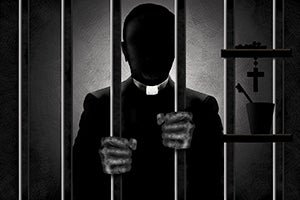
According to reporting by The Guardian, which you can read by clicking here, Catholic priest Michael Guidry, 83, has been released from prison after serving seven years for sexually abusing a teenage altar server, Oliver Peyton.
Guidry admitted to the abuse. He pleaded guilty. He was convicted and imprisoned. And yet, remarkably, he remains a Catholic priest. He may be prohibited from public ministry, but the Church has not removed him from the priesthood through a process known as laicization. He can still identify himself as a priest of the Catholic Church.
Now consider what happened to Oliver’s father, Scott Peyton.

Scott (seen at left with his wife, Letitia) was himself a Catholic deacon. Deacons in the Catholic Church are allowed to marry and have children. Deacon Peyton served alongside the very priest who abused his son. The discovery of that abuse devastated his family and fundamentally changed his relationship with the institution he had served. He resigned the diaconate.
Mr. Peyton subsequently sought refuge in an Anglican congregation, looking for somewhere his family could worship without being constantly reminded of the trauma they had endured at the hands of a Catholic priest.
For that, the Catholic Church excommunicated him.
Read that again – The priest who sexually abused a child remains a priest. The father who stood by his abused child and sought another place to worship was expelled from the Church.
If that isn’t a breathtaking example of institutional hypocrisy, what is?
The Vatican’s justification for upholding Scott Peyton’s excommunication was that joining an Anglican congregation represented a refusal to submit to the authority of the pope. Apparently, that was sufficient grounds for one of the Church’s most severe disciplinary measures. But where was that same determination when it came to dealing with a priest who sexually abused a child?
Where was the urgency? Where was the uncompromising commitment to the moral standards the Church so frequently preaches and demands of its members?
Where was the institutional outrage?
The Church seems perfectly capable of applying its rules when someone challenges its authority. It seems considerably less capable of demonstrating the same resolve when one of its own ordained ministers commits a terrible crime.

There is something deeply disturbing about a religious institution that can find the procedural machinery to excommunicate a grieving father, but apparently cannot bring itself to permanently remove a convicted child abuser from its priesthood.
We are told that Scott Peyton violated the Church’s expectations by joining another Christian community.
But what exactly did Fr. Michael Guidry violate?
Not some obscure technical provision of canon law. Not an administrative requirement. Not a disagreement over ecclesiastical authority.
He sexually abused a child.
If the Church’s disciplinary priorities are supposed to reflect the seriousness of wrongdoing, how can anyone defend this outcome?
There is another particularly ugly dimension to this story. Scott Peyton, his wife Letitia, and their family have already endured the devastating consequences of the abuse. They secured a $350,000 settlement from the Lafayette diocese and subsequently became advocates for survivors of clergy sexual abuse. Instead of being treated as people deserving compassion, dignity, and support, the family has found itself fighting the very institution that should have protected them.
Scott’s excommunication also affected his wife and six children, who were left feeling unwelcome in the Catholic community.
What kind of pastoral leadership produces that outcome? What kind of Christian witness tells a family devastated by the sexual abuse of a child that the greater problem is their father’s choice of church? And what kind of institution expects survivors and their families to remain loyal while demonstrating such extraordinary institutional loyalty to a convicted abuser?
The Church should be bending over backwards to reassure this family that they matter. Instead, it has made Scott Peyton’s religious affiliation the disciplinary issue.
The priorities are almost impossible to comprehend.
Let’s be clear: this is not an argument that the Catholic Church should abandon its traditions, ignore canon law, or stop expecting its clergy to uphold religious standards. It is an argument about moral proportion, accountability, and the most basic principles of Christian compassion.
Church authorities are entitled to have rules governing membership and religious affiliation. But rules do not exist in a moral vacuum. Their application says something about the values of the people enforcing them. When a father is excommunicated for seeking a different Christian community while a priest who admitted sexually abusing his son remains ordained, the Church has a serious credibility problem.
And it cannot simply hide behind canon law.
Canon law is not a substitute for morality. Institutional procedure is not a substitute for justice. And obedience to ecclesiastical authority should never become more important than protecting children.

The Lafayette diocese has an especially painful history with clergy sexual abuse. The scandal involving priest Gilbert Gauthe in the 1980s helped expose the wider crisis of sexual abuse within the American Catholic Church. Decades later, how is it possible that we are still confronting stories in which survivors and their families feel abandoned, while institutional responses appear more concerned with protecting the Church’s authority than demonstrating its compassion?
How many apologies does an institution get to issue before people are entitled to ask whether anything has actually changed?
The Catholic Church speaks constantly about forgiveness, repentance, redemption, compassion, and the protection of the vulnerable. These are worthy principles. But they cannot simply be words reserved for sermons.
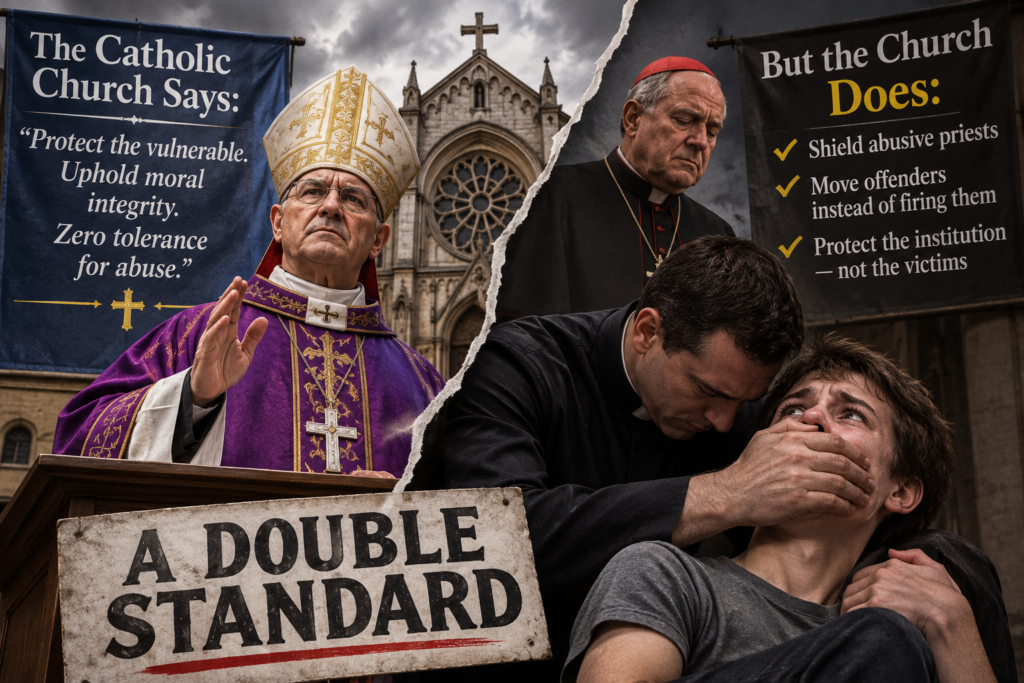
Forgiveness does not mean the absence of consequences. Redemption does not mean retaining every privilege and position regardless of what someone has done. And compassion certainly should not be distributed according to how convenient someone’s circumstances are for the institution. Ask yourself, thoughtful reader:
- If a convicted child abuser can remain a priest, why is a father who sought a safe spiritual home for his family beyond the Church’s embrace?
- If the Vatican can scrutinize Scott Peyton’s public statements and religious affiliations, why can’t the Church demonstrate equally determined scrutiny of the conduct of its own clergy?
- If institutional unity and submission are so important, why does the institution appear so willing to sacrifice the trust and dignity of an abused child’s family?
These are not unreasonable questions. They are questions the Church should be answering publicly.
The real scandal isn’t simply that Michael Guidry has been released from prison. He has served the sentence imposed by the criminal justice system, and his release is a matter of law. The scandal is that, after all this, the Church still recognizes him as a priest while maintaining the excommunication of the father of his victim.
The distinction matters.
One man committed a crime against a child. The other man was a father trying to navigate the devastation of what had happened to his son. Yet the Church’s disciplinary response has left the father formally excluded while the convicted priest retains his clerical identity.
That is an extraordinary inversion of moral priorities.
The Church cannot credibly preach that it stands with victims while treating their families this way. It cannot demand unquestioning loyalty while showing such questionable moral judgment. And it cannot expect the public to take its declarations about protecting children seriously if its own actions suggest that institutional authority takes precedence over the welfare of those children and their families.
The questions above should be directed at those who allowed this situation to happen, those who defended the decisions, and those who continue to regard the retention of a convicted child abuser in the priesthood as acceptable.
The Church owes the Peyton family more than sympathy and carefully worded statements. It owes them accountability. It owes survivors meaningful protection. And it owes the public an explanation for why the father was excommunicated while the priest who abused his son remains a priest.
Until those questions are answered, every sermon about compassion, justice, and protecting the innocent will ring painfully hollow. A Church that punishes the father and retains the abuser has its moral priorities catastrophically backwards.
And no appeal to canon law can make that look like Christianity.
